The Dirty Dozen: A UK Shopper’s Guide to Pesticides in Produce
Emma Wells
You may have seen the Dirty Dozen list online — but did you know the widely shared version is based on US data? For UK shoppers, PAN-UK publishes its own annual list based on British government testing. Here's what it reveals, why pesticide cocktails are a greater concern than single residues, and how to use the data to make smarter choices at the supermarket.
If you’ve seen the “Dirty Dozen” list, there’s a good chance it was published by the Environmental Working Group (EWG), a US-based non-profit that analyses pesticide residue data from American produce. While the EWG does valuable work, its findings are based on crops grown and sold in the United States, tested under US conditions using American agricultural data. The pesticides permitted, the growing practices used, and the food supply chain are all different here in the UK. That means the EWG list, while informative, is not the most reliable guide for UK shoppers.
Why the UK Needs Its Own List
The UK has it’s own version of the EWG Dirty Dozen, and it’s arguably more rigorous and relevant, in one important respect.
Every year, Pesticide Action Network UK (PAN-UK) analyses the results of the UK Government’s own residue testing programme and publishes the UK Dirty Dozen. PAN-UK focuses specifically on produce containing residues of two or more pesticides, what scientists call “pesticide cocktails”. This distinction matters enormously (more on that to follow).
What Are Pesticides and Why Do They Matter?
Pesticides kill living organisms. The term is an umbrella for thousands of different active chemicals, including herbicides, insecticides, and fungicides. A single crop can be treated with different pesticides many times during its growing season – wheat, for example, can be sprayed with as many as 20 different chemic al applications before harvest.
When pesticides are applied to food crops, they can leave detectable traces – known as residues – in or on the food we eat. The extent of contamination depends on which pesticides have been used, how recently they were applied, and how persistent they are (i.e. how quickly they break down).
Health risks
Research has identified a range of health concerns associated with pesticide exposure, particularly for vulnerable groups. PAN-UK highlights that young children and pregnant people are especially susceptible, as exposure to certain pesticides at critical stages of development can interfere with organ function. Endocrine disrupting chemicals (EDCs) are known to affect hormone systems, and have been associated with learning disabilities, attention deficit disorder, and cognitive and brain development problems.
Specific pesticides found in UK food have been linked to:
Cancer risk: Glyphosate (the world’s most widely used herbicide, found in a significant proportion of UK bread) has been repeatedly linked to various cancers. Thiacloprid, a neonicotinoid insecticide still found as a residue in UK produce, is classified as a human carcinogen. Imazalil, a fungicide widely used on citrus fruit, is also classified as a carcinogen, and a reproductive and developmental toxin.
Reproductive and developmental harm: Several pesticides commonly detected in UK food, including imazalil, chlorpyrifos and difenconazole, are classified as reproductive or developmental toxins. These can have adverse effects on sexual function and fertility, reduce sperm functionality, and may cause miscarriages.
Neurological harm: Chlorpyrifos, still found as a residue on some UK produce despite being banned in the EU, has been linked in multiple studies with lower birth weight and neurological changes in children, including slower motor development and attention problems.
Hormonal disruption: The herbicide 2,4-D, found on oranges, is an endocrine disrupting chemical with links to cancer. Fungicides from the ‘azole’ class are also suspected EDCs.
The cocktail effect – why multiple pesticides matter more than one
One of the most important but under-discussed aspects of pesticide exposure is what happens when chemicals combine. The UK’s regulatory system sets safety limits for one pesticide at a time. It does not account for what happens when you consume residues of five, ten or twenty different chemicals simultaneously, across a single meal, or a full day of eating.
This is what PAN-UK calls the cocktail effect. There is growing evidence that pesticides can become significantly more harmful when combined, even when each individual chemical falls below its permitted safety limit. By focusing on produce containing multiple residues, PAN-UK’s Dirty Dozen specifically targets this concern.
Environmental impact
Pesticide harms don’t begin and end on the supermarket shelf. The environmental consequences are wide-ranging and serious.
Neonicotinoid insecticides, a class of pesticides now banned in the UK and EU due to their devastating impact on pollinators, are nonetheless still detected on UK food imported from countries where they remain legal. Residues continue to appear in UK produce. As PAN-UK has noted, by continuing to import food grown with banned pesticides, the UK is effectively exporting its environmental responsibilities to other parts of the world, while bees and pollinators in those countries continue to suffer.
The PAN-UK Dirty Dozen 2025: Based on the Most Recent UK Data
PAN-UK publishes two versions of the Dirty Dozen to address the inconsistency of UK government testing, which tests different produce each year, making year-on-year comparisons difficult.
The 2024 Dirty Dozen (based on 2024 government testing)
This is the most recently tested produce, ranked by the percentage of samples found to contain two or more pesticide residues:
Grapefruit 99%
Grapes 90%
Limes – 79%
Bananas – 67%
Peppers (sweet) – 49%
Melons – 46%
Beans – 38%
Chilli peppers – 38%
Mushrooms – 31%
Broccoli – 26%
Aubergines – 23%
Dried beans – 21%
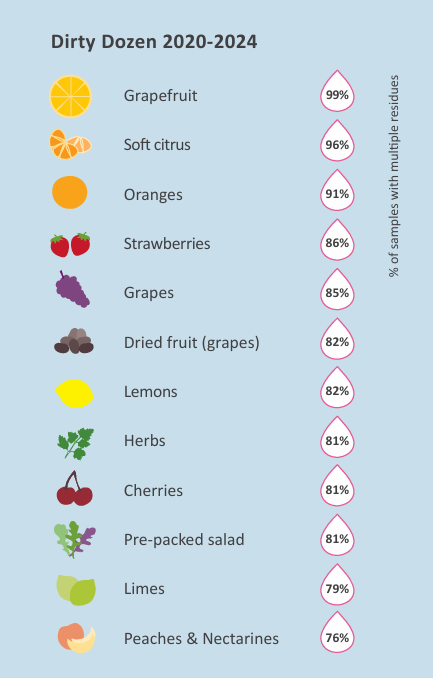
The Five-Year Dirty Dozen (2020–2024): The Bigger Picture
Because the government tests different items each year, some of the most persistently problematic produce doesn’t always appear in the annual snapshot. PAN-UK’s five-year composite list provides a clearer picture of which foods are consistently high in pesticide cocktails.
The five-year list is arguably the most useful for everyday shopping decisions, as it captures persistent trends rather than a single year’s snapshot.
A Note on Bread and Wine
PAN-UK’s work goes beyond fresh produce, and two findings deserve particular attention.
Bread: In 2024, the UK government tested 216 bread samples. Twelve different pesticide active substances were detected. Chlormequat, a plant growth regulator with concerns around birth defects, was found in 97% of bread samples. Glyphosate was present in 28% of bread tested. In 2021, 50% of bread contained multiple pesticide residues, double the proportion found a decade earlier. While this fell slightly to 47% in 2024, it remains deeply concerning given how frequently most people eat bread.
Wine: The last time wine was tested (2022), 50% of samples contained multiple pesticide residues, up from 14% in 2016. Organic wine is well worth considering for regular drinkers.
Does Washing Remove Pesticide Residues?
Unfortunately, not entirely. Washing produce can reduce surface residues and remove some traces of pesticide-contaminated soil. However, many of the pesticides used in modern agriculture are systemic, meaning they are absorbed by the plant. These residues are contained within the body of the produce and cannot be washed away.
Citrus fruit consistently shows some of the highest residue levels in government testing, largely because its peel traps more chemical residue. However, if you use citrus zest or juice citrus with the peel, those residues can be directly consumed. Handling heavily treated fruit also raises concerns about dermal absorption, particularly for children.
What About a “Clean Fifteen”?
You may have noticed that the EWG publishes a companion “Clean Fifteen” list, the 15 US-grown items least likely to carry pesticide residues. For 2025, the EWG’s Clean Fifteen includes: avocados, sweet corn, pineapple, onions, papaya, asparagus, honeydew melon, kiwi, watermelon, mushrooms, cabbage, mangoes, sweet peas (frozen), cauliflower, and bananas.
It is important to note that PAN-UK does not publish a UK equivalent of the Clean Fifteen. This is a deliberate and considered decision. Because UK government testing is so limited (only around 3,000kg of food is tested annually, with a different selection of produce chosen each year), PAN-UK is not willing to give the impression that any particular fruit or vegetable is reliably free from pesticide cocktails.
If you are using the EWG’s Clean Fifteen as a rough guide to lower-risk conventional produce, it is worth bearing in mind that it reflects US agriculture, not UK growing conditions and supply chains.
Practical Shopping Guide: How to Reduce Your Pesticide Exposure
Given everything above, here are practical steps you can take to minimise pesticide exposure for yourself and your family.
Prioritise organic for Dirty Dozen produce. Buying organic versions of the items on PAN-UK’s five-year list is the single most effective step.
Pay particular attention to citrus. If you use citrus zest or juice citrus fruit directly, organic is strongly worth the investment.
Consider organic bread, or look for brands that test for pesticides. Organic bread uses grain grown without synthetic pesticides and is now more widely available and affordable.
Rinse all produce thoroughly. While washing won’t remove systemic residues, it does reduce surface contamination, always a worthwhile step.
Be aware of imported produce. PAN-UK data indicates that imported produce carries pesticide cocktails more frequently than UK-grown (55% versus 31%). Choosing UK-grown where possible, particularly for items like strawberries and salad leaves, can make a difference.
Grow your own where possible. Even a small number of herbs, strawberries or salad leaves grown at home, without pesticides of course, can meaningfully reduce exposure.
The Bigger Picture
It is worth ending with an important note of reassurance: the evidence consistently shows that eating more fruit and vegetables, even if conventionally grown, is beneficial to health. The message from PAN-UK, and from nutritional therapists and health professionals broadly, is not to eat less produce, but to make more informed choices about which items to prioritise buying organic, and to advocate for stronger government action on pesticide reduction.
The UK Government’s pesticide safety limits remain inadequate in one critical respect: they assess chemicals individually, not as the cocktails we actually consume every day. Until that changes, tools like the PAN-UK Dirty Dozen are one of the most practical resources available to help consumers navigate their safer food choices with greater confidence.
Data Resources
Pesticide Action Network UK (PAN-UK). (2025). Dirty Dozen 2025 [based on 2024 UK Government residue testing data]. Retrieved from https://www.pan-uk.org/dirty-dozen/
Pesticide Action Network UK (PAN-UK). (2024). Previous UK government weakened pesticide safety limits in blow to consumer protection. Retrieved from https://www.pan-uk.org/food-safety-limits/
You may have seen the Dirty Dozen list online — but did you know the widely shared version is based on US data? For UK shoppers, PAN-UK publishes its own annual list based on British government testing. Here’s what it reveals, why pesticide cocktails are a greater concern than single residues, and how to use the data to make smarter choices at the supermarket.
Is anxiety really just stress? Discover how gut health, hormones, nutrient deficiencies and stress response may influence symptoms — and why a personalised approach matters.
Low energy, brain fog or poor focus? Learn how methylation affects energy, cognitive function and nutrient processing — and why methylation testing may help explain persistent symptoms.
More people than ever are using AI tools for health advice, from checking symptoms to looking at supplements. While AI can be a useful starting point, it cannot assess your personal history, medications, or test results. This article looks at where AI can help, and why individual health decisions still need professional guidance.
Manage Cookie Consent
We use technologies like cookies to store and/or access device information. We do this to improve browsing experience and to show (non-) personalised ads. Consenting to these technologies will allow us to process data such as browsing behaviour or unique IDs on this site. Not consenting or withdrawing consent, may adversely affect certain features and functions.
Functional
Always active
The technical storage or access is strictly necessary for the legitimate purpose of enabling the use of a specific service explicitly requested by the subscriber or user, or for the sole purpose of carrying out the transmission of a communication over an electronic communications network.
Preferences
The technical storage or access is necessary for the legitimate purpose of storing preferences that are not requested by the subscriber or user.
Statistics
The technical storage or access that is used exclusively for statistical purposes.The technical storage or access that is used exclusively for anonymous statistical purposes. Without a subpoena, voluntary compliance on the part of your Internet Service Provider, or additional records from a third party, information stored or retrieved for this purpose alone cannot usually be used to identify you.
Marketing
The technical storage or access is required to create user profiles to send advertising, or to track the user on a website or across several websites for similar marketing purposes.